Gold Breaks All Records, Surges Past $5,100 as Global Risk Fears Intensify
1/26/20262 min read
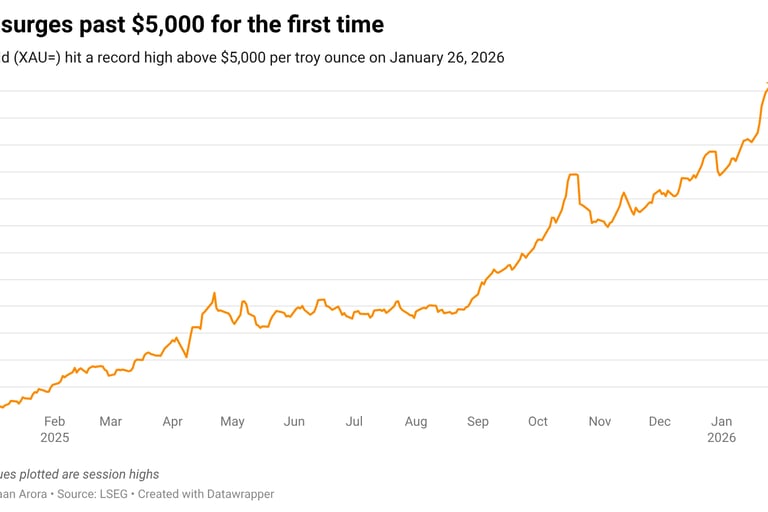
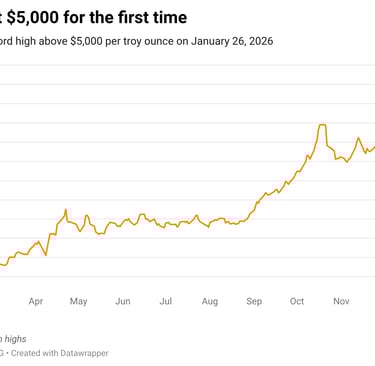
Gold prices surged to an all-time high of $5,100 per ounce on Monday, marking a historic milestone for global commodity markets as investors rushed into safe-haven assets amid escalating geopolitical tensions, financial market volatility, and growing uncertainty over global economic stability.
As of 09:15 IST (03:45 GMT), spot gold was trading near $5,085–$5,110 per ounce, reflecting intense buying pressure following a sharp sell-off in global equities and renewed concerns over trade conflicts and political instability.
What This Means for Investors
Gold’s record surge reflects deep-rooted concerns about global financial stability rather than short-term speculation. Retail investors, hedge funds, sovereign wealth funds, and central banks are all contributing to demand, making this rally broader and more resilient than past cycles.
In emerging markets like India, record global prices could translate into higher domestic gold rates, potentially impacting jewelry demand but strengthening gold’s role as a long-term store of value.
Is $5,100 Sustainable?
Market strategists believe gold’s breakout above $5,000 is not just psychological, it reflects a structural shift in global capital flows.
Unlike previous gold rallies driven primarily by inflation fears, this surge is supported by:
Long-term geopolitical fragmentation
Persistent global debt expansion
De-dollarization efforts by emerging economies
Central bank reserve diversification
Several global investment banks now project $5,300–$5,500 per ounce as a realistic medium-term target if geopolitical tensions persist and monetary easing accelerates.
However, analysts caution that short-term corrections remain possible, particularly if diplomatic tensions ease or economic data improves. Still, any pullbacks are expected to attract fresh buying interest.
Why Gold Is Rallying So Aggressively
Market analysts describe the surge as the result of a rare convergence of geopolitical, financial, and macroeconomic risks, pushing investors toward capital preservation rather than risk-taking.
Key drivers include:
1. Geopolitical Escalation and Trade Tensions
Recent threats by U.S. President Donald Trump to impose tariffs on European nations over the Greenland dispute triggered sharp declines in global equity markets, wiping out nearly $1.4 trillion in U.S. market value in a single session. Such uncertainty traditionally boosts demand for gold, which is widely viewed as a hedge against geopolitical risk.
2. Expectations of Global Rate Cuts
Central banks, particularly the U.S. Federal Reserve, have signaled a possible shift toward interest rate cuts starting in Q2 2026. Lower rates reduce the opportunity cost of holding non-yielding assets like gold, increasing its attractiveness among institutional investors.
3. Persistent Central Bank Accumulation
Central banks — led by China, Russia, and several emerging economies continue to increase gold reserves aggressively. This structural demand has significantly tightened supply, creating long-term upward price pressure.
4. Weakening Dollar and Rising Debt Concerns
Concerns about ballooning government debt, fiscal instability, and long-term dollar strength have further accelerated capital flows into precious metals.